
Having clear vision is something many people take for granted until things start to look a little blurry. If you’ve noticed that distant road signs are hard to read or that you need to hold your phone further away to see the screen, you might be experiencing a refractive error. These are the most common type of vision problem, affecting millions of people worldwide.
Myopia (Nearsightedness)
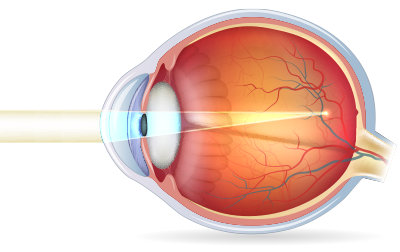
Myopia, more commonly known as nearsightedness, is a condition where you can see close objects clearly, but objects farther away appear blurry. It occurs when the eye grows too long from front to back, or when the cornea (the eye’s clear front surface) is too curved. This shape causes light rays to focus in front of the retina instead of directly on it.
Causes and Symptoms
Myopia often develops during childhood and adolescence and can run in families. The exact cause is a mix of genetic and environmental factors. Spending a lot of time doing close-up tasks, like reading or using screens, may increase the risk.
Common symptoms of myopia include:
- Blurry vision when looking at distant objects.
- Needing to squint to see clearly.
- Headaches caused by eye strain.
- Difficulty seeing while driving, especially at night.
Children with myopia might have trouble reading the board at school or sit closer to the television. An optometrist or ophthalmologist can diagnose myopia during a routine eye exam using a vision chart and a phoropter to determine the correct prescription.
Treatment Options
Myopia can be corrected in several ways:
- Eyeglasses: This is the simplest and most common treatment. The lenses are shaped to redirect light so it focuses correctly on the retina.
- Contact Lenses: Worn directly on the eye, contacts offer a wider field of vision and can be a great option for active individuals.
- LASIK: This surgical procedure permanently changes the shape of the cornea using a laser, correcting the refractive error. It’s a popular choice for adults who want to reduce their dependence on glasses or contacts.
Hyperopia (Farsightedness)
Hyperopia, or farsightedness, is the opposite of myopia. With this condition, you can typically see distant objects clearly, but objects up close may appear blurry. Hyperopia occurs when the eyeball is too short or the cornea has too little curvature. This causes light to focus behind the retina instead of on it.
Causes and Symptoms
Many people are born with mild hyperopia and outgrow it as their eyes develop. Like myopia, it can be hereditary. For some, the eye’s lens is flexible enough to compensate for the error, especially in younger people, so they may not notice any vision problems until they get older.
Common symptoms of hyperopia include:
- Blurry vision when looking at close-up objects.
- Eye strain, aching eyes, or burning sensations.
- Headaches after tasks that require close focus, like reading or computer work.
- Needing to squint to see nearby objects clearly.
A comprehensive eye exam is needed to diagnose hyperopia. The eye doctor will assess how your eyes focus light and determine the prescription needed to correct your vision.
Treatment Options
Corrective options for hyperopia are similar to those for myopia:
- Eyeglasses: Convex lenses are used to bend light rays inward, allowing them to focus on the retina.
- Contact Lenses: These provide the same correction as glasses but sit directly on the eye.
- Refractive Surgery: Procedures like LASIK can also be used to reshape the cornea and correct farsightedness, offering a long-term solution.
Astigmatism
Astigmatism is a common condition that causes blurred vision at all distances. It occurs when the cornea or the lens inside the eye has an irregular, egg-like shape instead of being perfectly round. This imperfection prevents light from focusing to a single point on the retina, resulting in distorted or blurry vision.
Causes and Symptoms
Most people with astigmatism are born with it, and it often occurs alongside myopia or hyperopia. It can also develop after an eye injury, eye disease, or surgery.
Symptoms of astigmatism can include:
- Blurry or distorted vision at both near and far distances.
- Eye strain and discomfort.
- Headaches.
- Difficulty with night vision.
- Squinting to try to see clearly.
Astigmatism is diagnosed during a standard eye exam. An instrument called a keratometer can measure the curvature of your cornea to determine the extent and axis of the astigmatism.
Treatment Options
Astigmatism is highly correctable. Available treatments include:
- Eyeglasses: Special cylindrical lenses are used to compensate for the cornea’s irregular shape.
- Toric Contact Lenses: These are specially designed soft or rigid gas permeable contact lenses that are weighted to stay in the correct position on the eye, providing clear vision.
- LASIK: This surgery can be very effective for correcting astigmatism by reshaping the cornea to be more symmetrical.
Presbyopia
Presbyopia is a unique refractive error that is a natural part of the aging process. It’s the gradual loss of your eyes’ ability to focus on nearby objects, and it typically becomes noticeable in your early to mid-40s and continues to worsen until around age 65.
Causes and Symptoms
Unlike the other refractive errors, which are related to the shape of the eyeball, presbyopia is caused by the hardening of the lens inside your eye. As you age, the lens becomes less flexible, making it difficult for the eye to change focus from distant to near objects.
The most common signs of presbyopia include:
- A tendency to hold reading material farther away to make the letters clearer.
- Blurred vision at a normal reading distance.
- Eye strain or headaches after reading or doing close-up work.
- Needing brighter lighting for close tasks.
An eye doctor can diagnose presbyopia with a basic eye examination, using ophthalmology EMR software to document and analyze the findings, and confirm it by testing your near vision.
Treatment Options
There are several effective ways to manage presbyopia:
- Reading Glasses: Over-the-counter or prescription reading glasses are a simple solution for those who only need correction for near vision.
- Bifocals or Trifocals: These eyeglass lenses have two or three different prescription strengths, allowing for clear vision at multiple distances.
- Progressive Lenses: These offer a seamless transition between near, intermediate, and distance vision without the visible lines of bifocals.
- Multifocal Contact Lenses: Similar to progressive eyeglasses, these contacts have different zones for near and far vision.
- Monovision: With this method, one eye is corrected for distance vision (usually with a contact lens) and the other is corrected for near vision.
Conclusion
Now that you understand the various options for correcting presbyopia, it’s important to consult with your eye doctor to determine the best solution for your specific needs. They will take into consideration factors such as your age, lifestyle, and overall eye health when recommending a treatment plan.
Keep an eye for more latest news & updates on Discover Heading!